

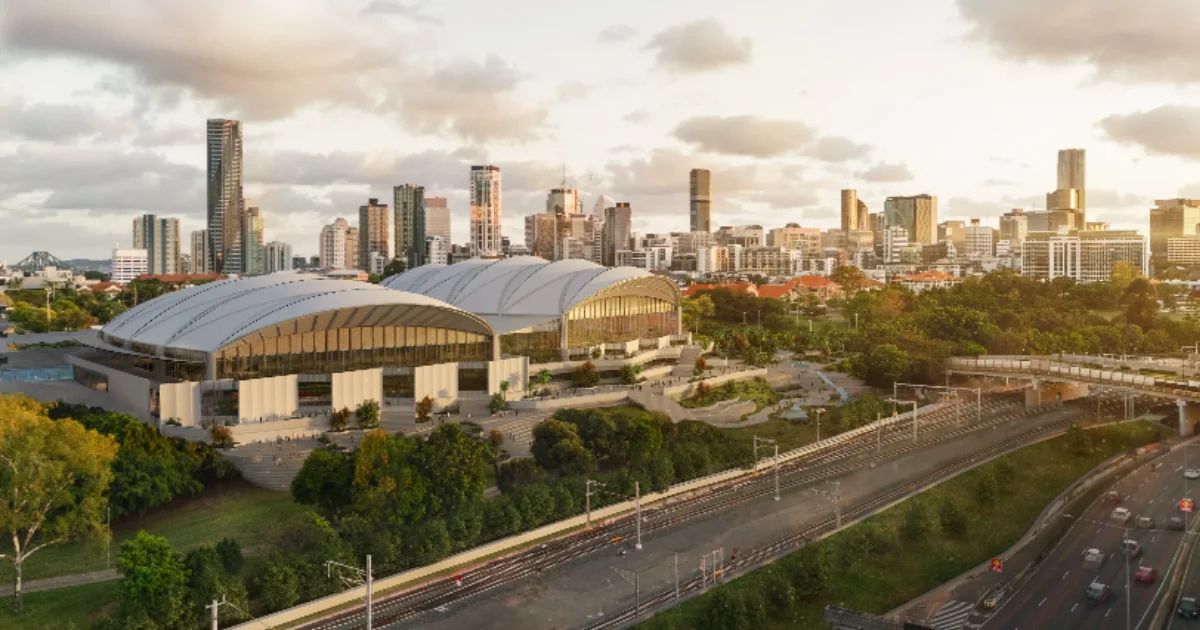
The cost of building Brisbane’s National Aquatic Centre (NAC) for the 2032 Olympic and Paralympic Games has nearly doubled, now projected at $1.2 billion.
Read: Spring Hill to Become Home of Australia’s Largest Aquatic Venue for 2032 Games
The revised figure, confirmed by the Games Independent Infrastructure Authority (GIICA), is significantly higher than the $650 million originally estimated by Swimming Australia earlier this year.


Despite the price increase, officials say the scope of the project in Spring Hill remains largely unchanged. GIICA chair Stephen Conry said the updated figure reflects a more realistic assessment of the project’s cost and emphasised that the aquatic centre will be a long-term investment for Queensland. He described the NAC as a world-class facility that will serve as a national hub for aquatic sports and provide lasting benefits for future generations.

Once complete, the aquatic centre will be the second most expensive Olympic venue after the $3.8 billion main stadium at Victoria Park, located less than a kilometre away. The NAC is expected to be funded through a partnership with the federal government.


The higher price tag does not come as a surprise to many involved in the planning process, who had questioned the earlier cost estimate. Planning for the centre had been constrained by the tight time frame of GIICA’s 100-day review earlier this year, which did not allow for detailed cost analysis.
Shifting the $2.5 billion Brisbane Arena project to private sector funding has freed up public funds, allowing the NAC and other venues—such as a proposed rowing course in Rockhampton—to move forward.


Work is already underway to assess whether the Fitzroy River in Rockhampton can be adapted to meet Olympic requirements. While initial assessments suggested limitations, GIICA is now conducting further studies to explore its feasibility.
Read: Fortitude Valley Builders Join $7.1b Olympic Push
Construction of the National Aquatic Centre is expected to begin in late 2026 or early 2027. Conry said planning is progressing well, though he acknowledged that unexpected challenges are common in large infrastructure projects. He expressed confidence that the delivery timeline remains on track and suggested public support for the Games continues to grow.
Published 23-July-2025