


Lachlan Kennedy’s rise to the top of Australian sprinting has drawn strong recognition from those who watched his early development, with his former school, St Joseph’s College, Gregory Terrace, describing his latest performance as a moment of breaking barriers. The school noted Kennedy’s first national 100m title, his 9.96-second run, and his ability to back up a record-breaking heat with another elite performance in the final, highlighting composure and consistency at the highest level.
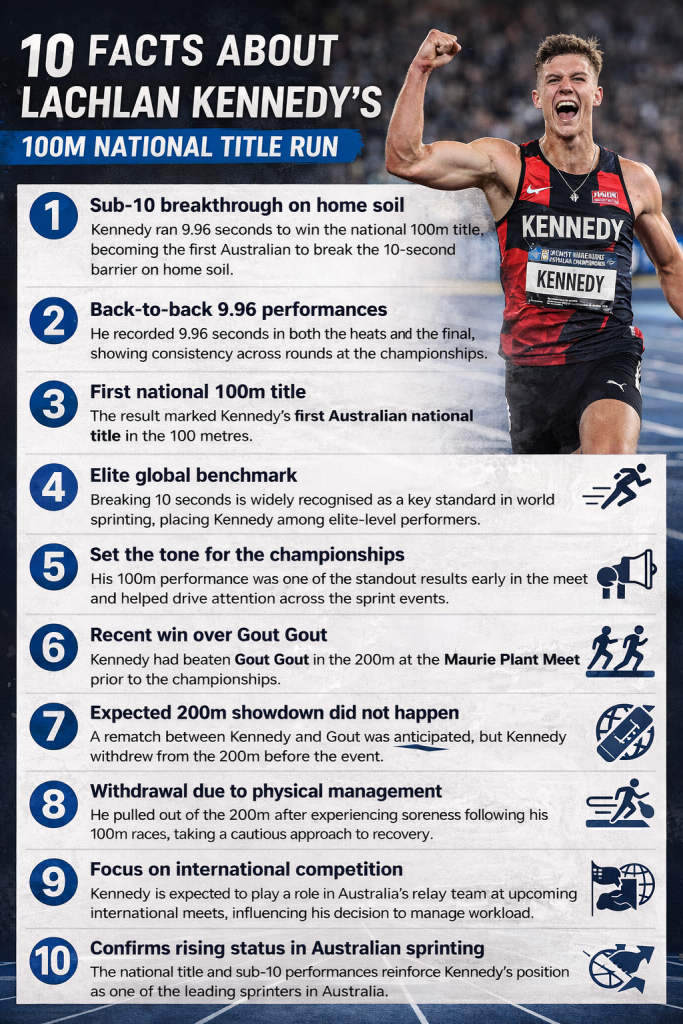
Kennedy delivered that performance at the Australian Athletics Championships, where he ran 9.96 seconds in both the heats and the final to secure the national title. The back-to-back efforts reinforced his standing as one of the country’s leading sprinters, with the consistency of the times a key feature of the result.

A breakthrough at the highest level
The 9.96-second run carries significance beyond the title itself. It marked the first time an Australian has broken the 10-second barrier on home soil, placing Kennedy in a small group of athletes who have achieved sub-10 times internationally.
Breaking 10 seconds is widely recognised as a benchmark in sprinting, separating national-level performers from those competing at the highest global standard. Kennedy’s ability to produce that time twice in one meet highlights both speed and execution under pressure.


From contender to national champion
Kennedy’s result builds on a period of steady progression. Earlier this year, he drew attention with strong performances, including a win over Gout Gout in the 200 metres at the Maurie Plant Meet. That race, along with previous results, positioned him as a contender heading into the national championships.
The Australian Athletics Championships was shaped by the presence of both Kennedy and Gout, two young sprinters producing standout results across different events. While Kennedy claimed the 100m title, Gout later went on to break the national 200m record, cementing the future of Australian sprinting.
There had been strong interest in a potential rematch between the pair in the 200m. However, Kennedy withdrew from that event on race day after experiencing soreness following his 100m efforts.


Performance built on control and execution
Across the championships, Kennedy’s racing stood out for its consistency. Running identical times in both the heats and final requires not only physical speed but also control through each phase of the race.
His start, transition and finish phases remained stable across both runs, allowing him to deliver under pressure. That level of execution is often cited as a key factor separating elite sprinters from the rest of the field.
A new benchmark
With Kennedy in the 100m and emerging athletes across other distances, there is growing depth in men’s sprinting. The national championships provided a snapshot of that shift, with multiple athletes producing personal bests and competitive times.
Kennedy’s national title marks a significant step, but it also sets a new benchmark for what follows. With international competitions approaching, including relay events, attention will turn to how these performances translate onto the global stage.
Published 14-April-2026