



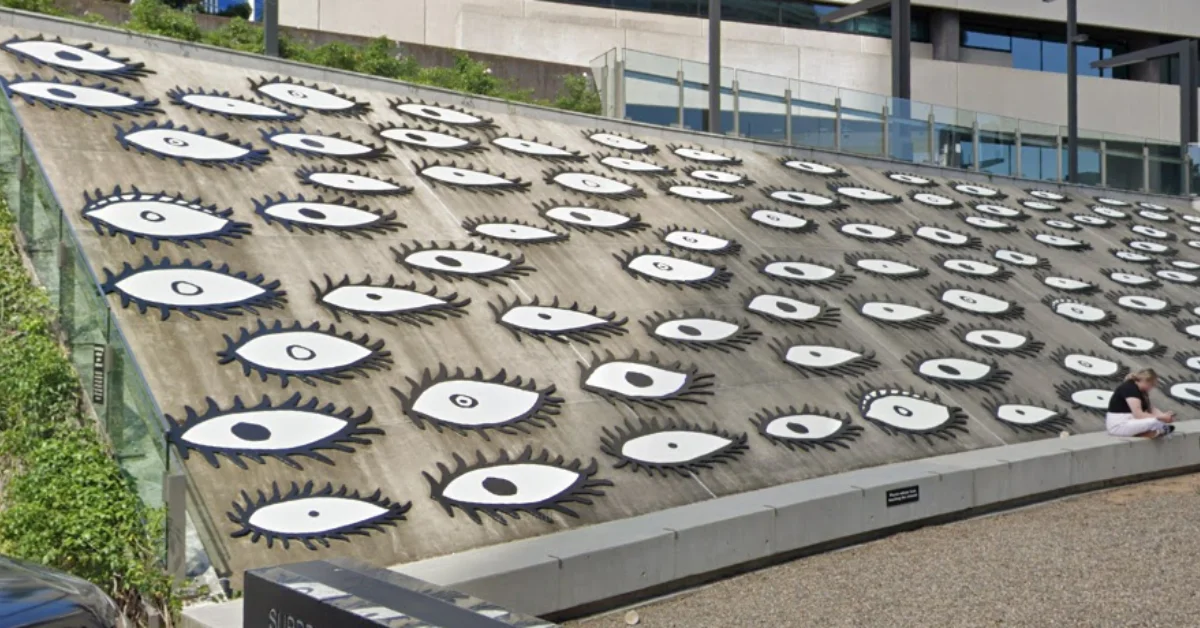
Japanese artist Yayoi Kusama has died aged 97, leaving behind a body of work that remains visible in Brisbane through her permanent public artwork outside the Queen Elizabeth II Courts of Law.
Read: Brisbane Artist Renee Kire Brings Colour and Movement to Museum of Brisbane Entryway
Kusama died in a hospital in Tokyo on 14 August 2026, according to a statement from the Yayoi Kusama Museum. Her death marked the end of a career spanning more than seven decades, during which she became an internationally recognised figure in contemporary art.

At 415 George Street, one of Brisbane’s visible reminders of Kusama is Eyes Are Singing Out, where 312 steel and enamel eyes stretch along a curved wall beside the courts.
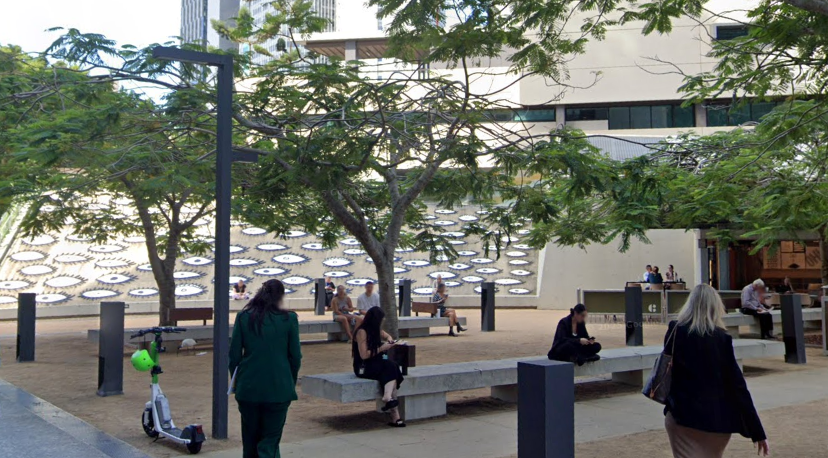
Created for the Queen Elizabeth II Courts of Law, the artwork was installed in 2012. The 90-metre installation occupies the public plaza between the Supreme Court and Magistrates Court buildings, placing Kusama’s work directly within Brisbane’s public streetscape.

Visible from George Street, the installation sits alongside the formal architecture of the courts. The artwork has been interpreted as engaging with ideas of observation and transparency in the context of its setting beside the courts.

The Life Of Yayoi Kusama
Born in Matsumoto, Japan, in 1929, Kusama developed an interest in art from an early age. She began producing drawings and paintings before developing the repeated forms, patterns and dots that would eventually become hallmarks of her practice.
Her career encompassed a wide range of artistic forms. Sculpture and installation became central to her work, while she also explored painting, performance, film and video, fashion, poetry and fiction.
Across these different forms, she repeatedly explored repetition, accumulation and infinity, themes that became closely associated with her practice. Her work also incorporated autobiographical and psychological themes drawn from her own experiences.


In the late 1950s, Kusama moved to the United States and settled in New York, where she became part of the city’s avant-garde art scene. During the 1960s, she produced large-scale installations and performances, including works that incorporated her developing use of repetition, dots and audience participation.
Her polka dots became particularly recognisable, appearing across paintings, sculptures, rooms and public spaces. The repeated patterns became a way of exploring ideas of infinity and self-obliteration.
Kusama spoke publicly about experiences that influenced her artistic practice, including hallucinations and psychological distress. She later returned to Japan, where she continued to produce paintings, sculptures and installations throughout the following decades.
A Long Connection With Brisbane
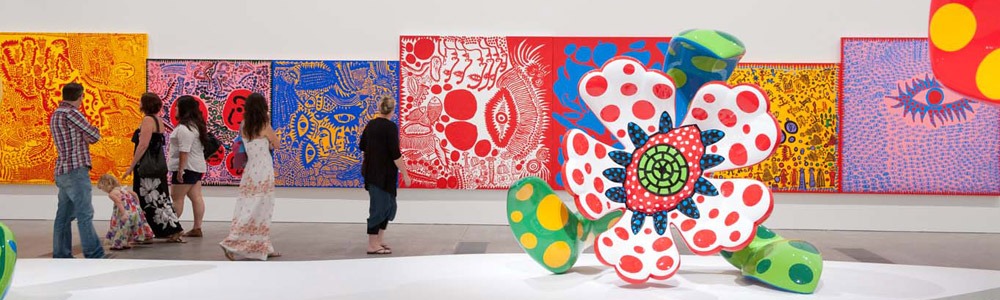
Kusama had an established connection with Brisbane before Eyes Are Singing Out was installed. She first exhibited at the Queensland Art Gallery in 1989 and later collaborated with the Gallery on The obliteration room for the 2002 Asia Pacific Triennial.
The interactive work was developed as a children’s project before being reworked and enlarged for Kusama’s 2011 GOMA exhibition, Yayoi Kusama: Look Now, See Forever. Visitors gradually transformed the initially white room by placing brightly coloured dot stickers across its surfaces.
The 2011-12 exhibition brought together Kusama’s painting, sculpture, video and installation work at GOMA. She returned to the gallery in 2017 for Life is the Heart of a Rainbow, an exhibition spanning her career and artistic practice.
Read: Sydney-based Artist Mirra Whale Brings ‘Quiet and Still’ Beauty to Fortitude Valley
Her distinctive installations and immersive works helped bring her art to audiences well beyond conventional gallery spaces. By her later years, Kusama was an internationally recognised artist whose work had been exhibited by institutions around the world.
In Brisbane, her legacy can still be encountered in the city’s public spaces. The eyes on George Street remain in place as a permanent Brisbane work by an artist whose distinctive use of repetition, dots, colour and immersive installations became recognised internationally.
Published 10-September-2026