



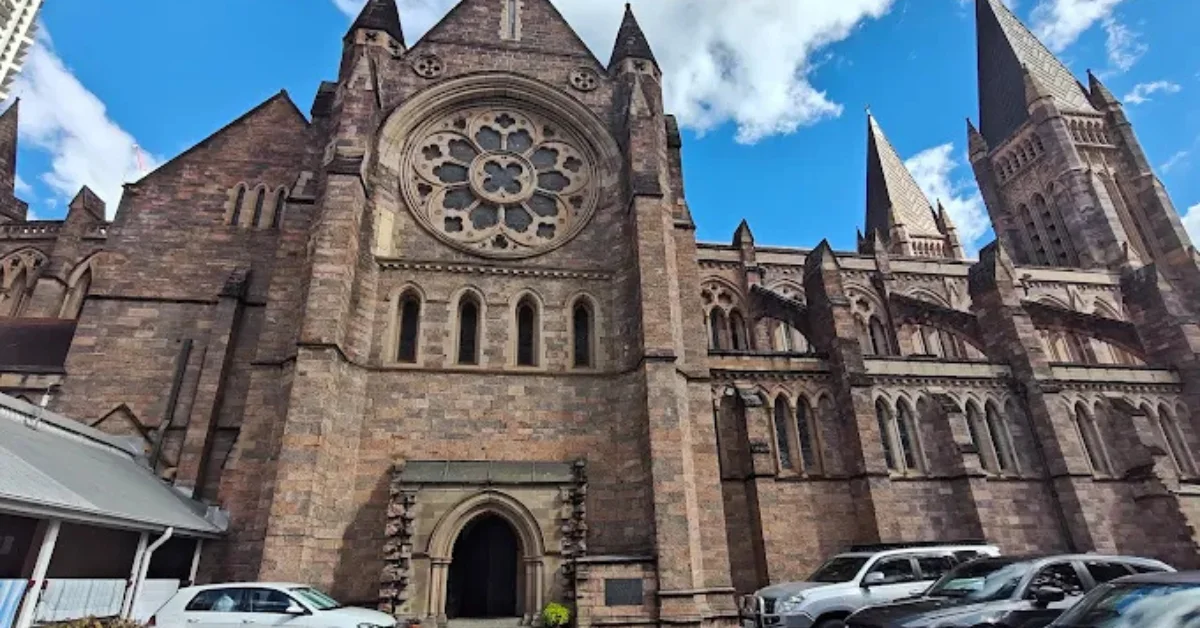
Why It Took More Than A Century To Build St John’s Cathedral

Did you know that St John’s Cathedral on Ann Street was built over three separate stages spanning two centuries? From the laying of its foundation stone in 1901 to the completion of its western towers and spires in 2009, the city’s Anglican cathedral took 108 years to realise its original vision and is one of the few Gothic cathedrals in the world completed using traditional hand-cut stone.


Read: Brisbane to Welcome New Archbishop Following Historic Vatican Appointment


Standing at 405 Ann Street in Brisbane City, on the edge of Fortitude Valley, the cathedral tells a story that extends well beyond its architecture. It reflects more than a century of public support and the commitment of generations of architects, stonemasons, clergy and supporters who worked to complete a design first conceived during the Victorian era.

A Vision That Spanned Generations
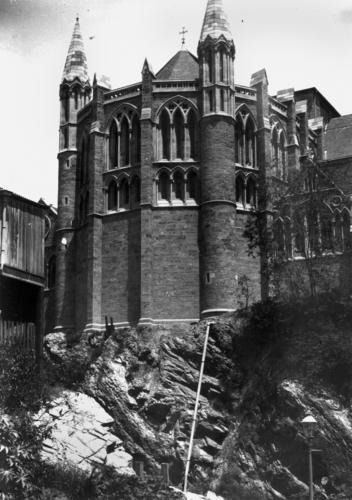
St John’s Cathedral
Back view of St John’s Cathedral taken from the cutting in Adelaide Street, ca 1910 (Photo credit: Agriculture and Stock Department, Publicity Branch/Queensland State Archives)

The cathedral project began in the 1880s when William Webber, Brisbane’s third Anglican bishop, commissioned English architect John Loughborough Pearson to prepare plans for a new cathedral. The proposal formed part of celebrations marking Queen Victoria’s Golden Jubilee in 1887 and was intended to be funded through public subscriptions.

Financial constraints meant the cathedral could not be completed in a single campaign. Instead, construction unfolded across three major stages over more than a century.

The foundation stone was laid in 1901 by the Duke of Cornwall and York, who later became King George V. The first stage of construction began in 1906 and was completed in 1910, delivering the sanctuary, transepts, choir, Lady Chapel and the first section of the nave.
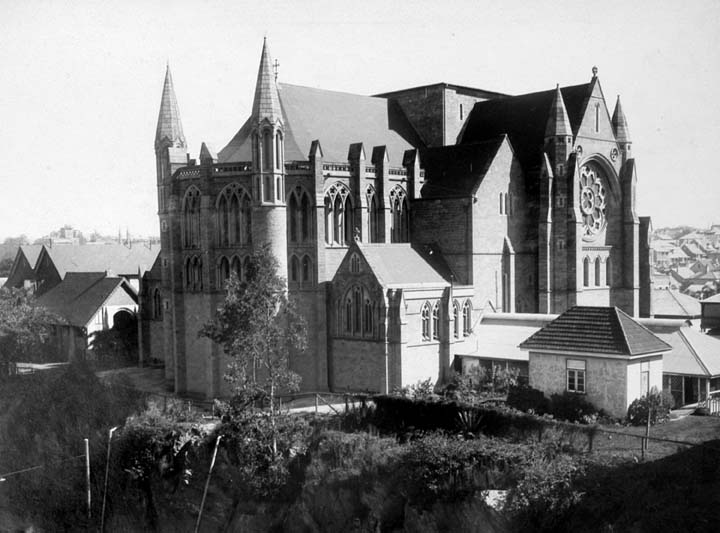
The apse and crossing in 1927 (Photo credit: Agriculture and Stock Department, Publicity Branch/Queensland State Archives)

Following the Second World War, efforts resumed to complete the cathedral as a war memorial. A new foundation stone was laid in 1947 by Field Marshal Viscount Montgomery of Alamein, although construction did not recommence until 1965. The second stage continued until 1969, extending the nave and laying the groundwork for the final phase.

The third and final stage began in 1989. Supported by public donations, bequests and funding from the Australian, Queensland and Brisbane governments, work continued for two decades before the western towers and copper-clad spires were completed in 2009, bringing Pearson’s original vision to completion 108 years after the foundation stone was laid.

Built Using Traditional Craftsmanship
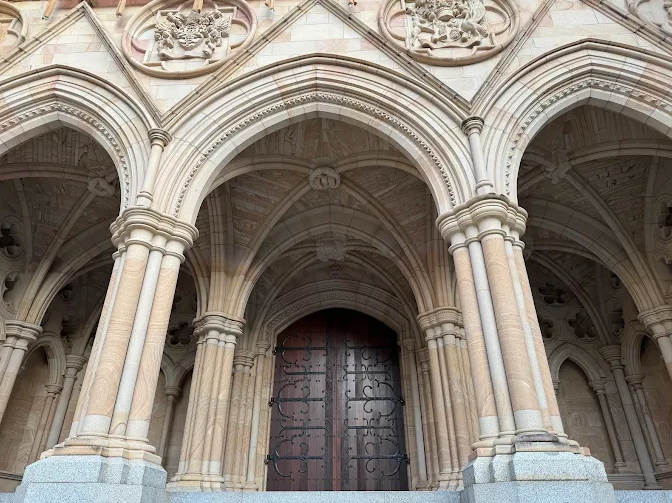
Photo credit: Google Maps/Alex Hu

What makes St John’s Cathedral distinctive is not only how long it took to build, but also the methods used during its construction.

The cathedral was built using traditional medieval construction techniques with load-bearing stone throughout the structure. Skilled stonemasons shaped and laid much of the stone by hand, preserving the original design and construction methods throughout each stage of the project.

The exterior walls feature Brisbane tuff quarried from the former O’Connelltown quarry at Windsor, giving the cathedral its distinctive brown, pink and mauve appearance. Inside, visitors can find columns carved from Frosterley limestone imported from England, a stone estimated to be around 350 million years old and known for its visible fossilised coral.

The building is also home to the only fully stone-vaulted ceiling in the Southern Hemisphere. Its acoustics produce an echo of around five seconds, complementing the cathedral’s pipe organ, recognised as the largest cathedral organ in Australia.

A Landmark For Brisbane
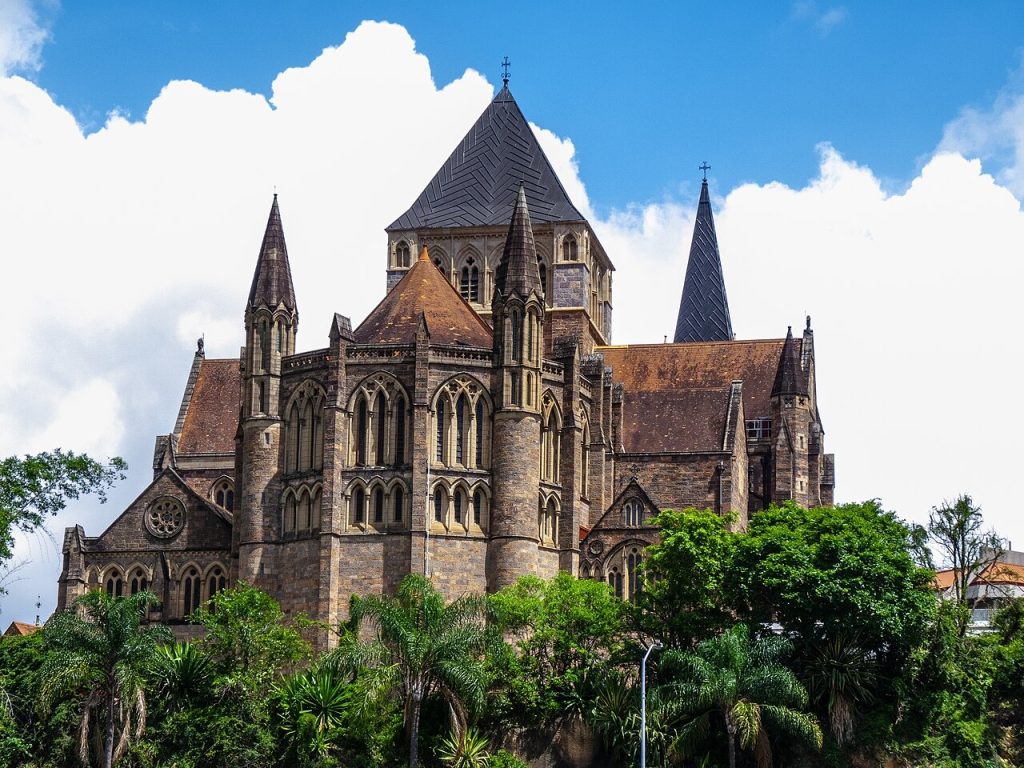
St John’s Cathedral East End from Queen Street, 2010 (Photo credit: CC BY-SA 4.0/John Robert McPherson/Wikimedia Commons)

Beyond its role as a place of worship, St John’s Cathedral is recognised as one of Brisbane’s important heritage landmarks. Its stained-glass windows incorporate Australian wildlife, while carvings throughout the building include details such as whales and a rainbow serpent woven into the Gothic stonework.

The cathedral continues to host regular services, concerts, guided tours and bell tower tours, welcoming visitors throughout the year.


Read: Archbishop Shane Mackinlay Installed in Fortitude Valley


Its completion in 2009 coincided with Queensland’s Q150 celebrations, during which St John’s Cathedral was recognised as one of the state’s Q150 Icons for its role as a structure and engineering feat.

More than a century after construction first began, the cathedral stands as a lasting example of the vision and persistence behind one of Brisbane’s most distinctive historic buildings.

Published 16-July-2026

Brisbane to Welcome New Archbishop Following Historic Vatican Appointment

Brisbane is set for a new chapter in Catholic leadership, with Bishop Shane Mackinlay chosen by Pope Leo XIV as the next Archbishop of Brisbane.


A Leader with Local Ties and Global Experience

The Vatican announced on June 18 that Bishop Shane Mackinlay will replace retiring Archbishop Mark Coleridge after 13 years leading Brisbane’s Catholic community. Mackinlay, who has served as Bishop of Sandhurst since 2019, will be formally installed at St Stephen’s Cathedral on September 11. 

Born in Melbourne and raised in Ballarat, he graduated dux of St Patrick’s College in 1982 and became a priest in 1991. He served in several Victorian parishes and later taught at Catholic Theological College and Australian Catholic University.

Mackinlay also earned a doctorate in philosophy from Leuven in Belgium and was later named Associate Professor at the University of Divinity.

What This Means for Brisbane’s Catholic Community

The Archdiocese of Brisbane, home to more than 660,000 Catholics across 103 parishes, will look to Bishop Mackinlay for its next chapter. He steps in after years of Church renewal, including his leadership roles in the Australian Plenary Council and the Synod on Synodality. 

These efforts aimed to make Church life more inclusive and connected to everyday communities. Mackinlay’s approach has centred on listening and practical engagement. His move to Brisbane is expected to carry that same focus forward.

Smooth Handover with Praise from Retiring Archbishop

Outgoing Archbishop Mark Coleridge has welcomed Shane Mackinlay’s appointment, calling him a clear thinker with strong leadership and a balance of vision and local focus. Coleridge, who led the Archdiocese for more than a decade, said Mackinlay is well prepared for the role. 

Mackinlay said he is honoured by the appointment and thankful for his time in the Sandhurst Diocese. He noted the difficulty of leaving a close-knit regional community. Still, he expressed enthusiasm for working with the people of Brisbane and continuing the progress already underway.

Farewell and Welcome Services Planned

A Mass of Thanksgiving will be held in Bendigo on September 7, marking Mackinlay’s final formal act as Bishop of Sandhurst. Just days later, he’ll be installed in his new role at a public Mass in Brisbane.


Catholics across both dioceses are preparing for the transition, which Church officials say is a time for reflection and opportunity. Mackinlay is expected to continue his hands-on pastoral approach while supporting the ongoing spiritual, educational and social services work across Brisbane.

Published 02-July-2025

Queenslanders Reflect at St Stephen’s Cathedral as Pope Francis Mourned

Mourners gathered at St Stephen’s Cathedral in Brisbane’s CBD to honour the life and legacy of Pope Francis, just hours after news broke of his death at the Vatican on Easter Monday. 


Archbishop Mark Coleridge led a heartfelt Mass on Tuesday to honour Pope Francis, a man he once called a “dear brother.”

The early morning Mass on Tuesday drew about 40 members of the community who came to reflect, pray, and give thanks for the Pope’s contributions to the Catholic Church and beyond. The Archbishop spoke about the significance of the timing of the Pope’s passing—so close to Easter—and acknowledged the lasting changes Pope Francis made during his time as leader of the global Church.

Remembering a Leader Who Re-shaped the Papacy

Archbishop Coleridge shared personal reflections during and after the Mass, recalling how Pope Francis consistently challenged tradition not for the sake of disruption, but to reshape the Church into something more compassionate, inclusive, and grounded in humility. He described Francis as a man of “surprise” who often defied expectations, including his own election in 2013.

The Archbishop said he once dismissed Jorge Bergoglio—then the Archbishop of Buenos Aires—as an unlikely papal candidate due to his age and background as a Jesuit. But his eventual election, and the simplicity with which he introduced himself to the world, showed a leader who would steer the Church in a new direction.

Coleridge noted Pope Francis’s tendency to break away from Vatican formality. Instead of living in the grand Apostolic Palace, he chose a modest residence and often opted for a small sedan rather than official vehicles. He greeted others with warmth and informality, signalling his desire to be a “bishop among bishops,” not a distant authority figure.

Local Reflections and Community Mourning

For Queenslanders like Georgia Meares, attending the Mass was a chance to both grieve and express hope for the Church’s future. She spoke about her prayers for the Pope, the broader Church community, and the selection of a new leader. Her thoughts echoed those of many who admired Pope Francis for his down-to-earth style and focus on the poor and vulnerable.

The Cathedral will continue to welcome community members for quiet reflection throughout the traditional nine-day mourning period observed by the Church following a Pope’s death.

Queensland Premier David Crisafulli acknowledged the Pope’s passing by ordering flags to be flown at half-mast across state government buildings. He said Pope Francis was someone who gave “a voice to the voiceless” and served with commitment until the end of his life. The Premier is expected to meet with Archbishop Coleridge to extend condolences on behalf of the state and its large Catholic population.

A Legacy That Will Endure

Archbishop Coleridge believes Pope Francis’s influence on the Church will carry forward, describing his reforms and priorities as changes that “can’t be stopped.” He referred to him not just as the Holy Father, but as a dear brother, a title he used in their correspondence to reflect a shared sense of mission and fraternity.

Throughout his life, Pope Francis remained grounded in his Jesuit values, placing the needs of the poor and marginalised at the heart of his ministry. His papacy marked a shift towards a more pastoral and globally conscious Church, driven by service rather than status.


As the Church now prepares for the conclave to elect a new pope, uncertainty surrounds who might be chosen next. Archbishop Coleridge said it is as unpredictable now as it was when Pope Francis was elected—perhaps fitting for a man whose life and leadership were marked by the unexpected.

Published 22-April-2025