


By Jack Mercer – Rabbit Hole Fisherman
Six minutes, no chorus, and a record nobody quite knew what to do with:
How Queen made Bohemian Rhapsody
There are songs that sound unusual the first time you hear them. Then there is Bohemian Rhapsody, a song so unusual that after 50 years of weddings, stadiums, car stereos, films and drunken singalongs, we’ve somehow stopped noticing.
In This Story
- Freddie Mercury already knew where he wanted to go
- They actually left a hole in the song
- How did Queen create all those voices?
- Nobody heard the complete song until it was assembled
- Why wasn’t Bohemian Rhapsody shortened for radio?
- Kenny Everett helped turn the problem into an event
- And then Queen had to work out how to promote it
- What is Bohemian Rhapsody actually about?
- Then something extraordinary happened: it came back
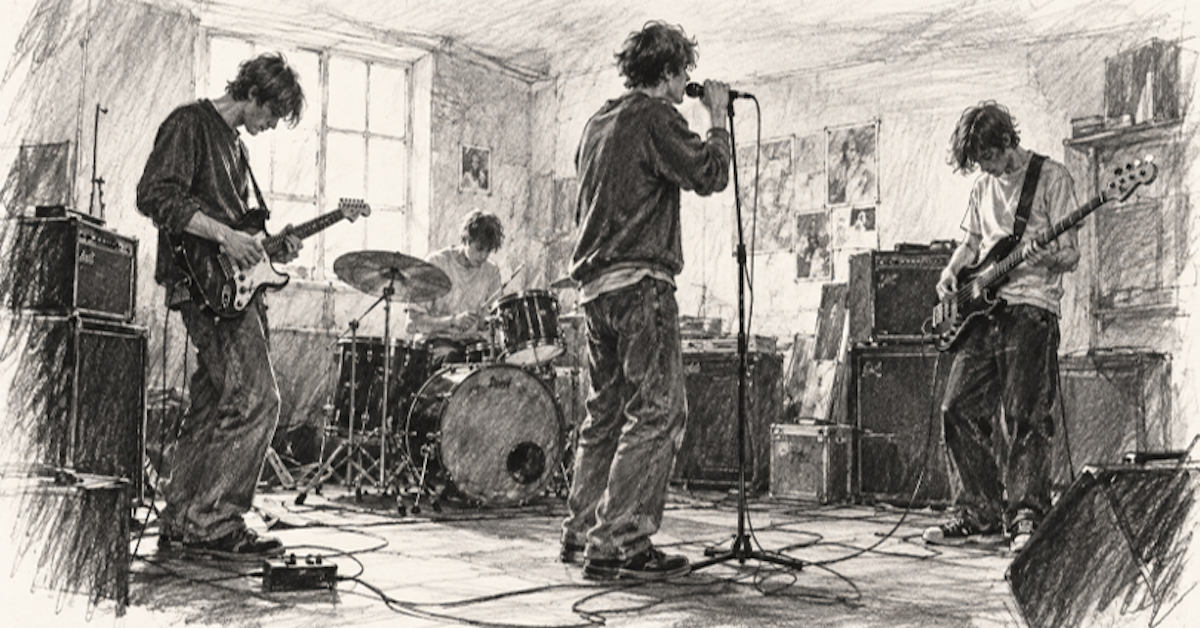
Listen to it as though you’ve never heard it before. It runs for almost six minutes, there’s no conventional chorus, and a piano ballad gives way to an operatic section populated by massed voices before crashing into hard rock and retreating into a surprisingly quiet ending.
In 1975, Queen wanted this to be a single, and plenty of people had doubts. The remarkable part isn’t simply that Bohemian Rhapsody succeeded. It spent nine weeks at No. 1 in Britain and eventually became the UK’s biggest-selling single originally released during the 1970s.
The remarkable part is how four musicians and a producer managed to get something this complicated onto tape in the first place. There was no computer screen in front of them, and there wasn’t even enough tape.
Freddie Mercury already knew where he wanted to go
By 1975, Queen weren’t unknowns looking for their first break. Freddie Mercury, Brian May, Roger Taylor and John Deacon had released three albums. Sheer Heart Attack had been a substantial success, and Killer Queen had given them a major international hit.
But Bohemian Rhapsody was another proposition altogether. Producer Roy Thomas Baker had worked on Queen’s first three albums, and he later recalled Mercury playing him the new composition on piano before recording began. The song was already conceived in sections, but what nobody yet knew was quite how enormous one of those sections was going to become.
After about three weeks of rehearsal, recording began at Rockfield Studio in Wales on 24 August 1975. Work would eventually spread across another four studios, which is a reminder of just how difficult the band’s ambition was to contain.
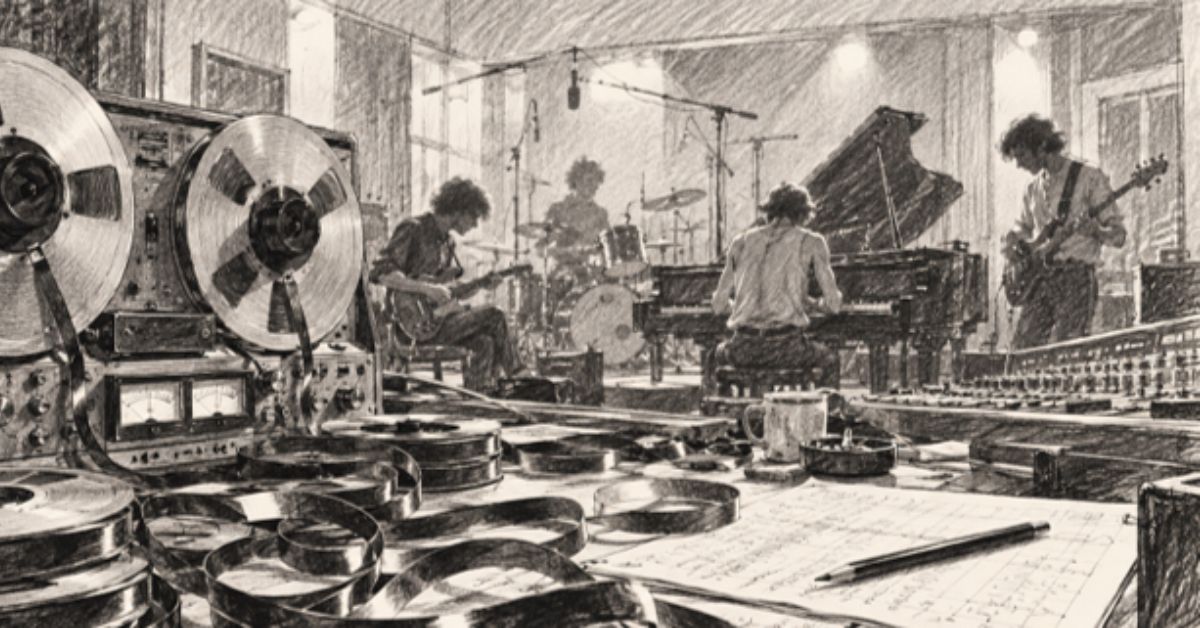
Think about what Queen were attempting. Today, a musician constructing a six-minute recording from radically different sections can see the entire song laid out on a computer, with parts moved, copied, extended and layered almost without limit. Queen had 24-track analogue tape and scissors.
They actually left a hole in the song
This might be my favourite part of the whole story. Queen initially recorded Bohemian Rhapsody in pieces. The piano-led section was recorded conventionally enough, and the heavy rock section was treated almost like a separate song. But the operatic section in between wasn’t there yet.
So they left approximately 30 seconds of blank tape for it. Then Freddie Mercury kept having ideas. The opera got bigger, thirty seconds wasn’t enough, and Baker’s solution was wonderfully physical: they spliced more tape into the reel. And then more.
What we now regard as an inevitable part of one of the world’s most familiar songs was literally expanding because Mercury kept expanding the idea. Baker remembered the reel eventually becoming a patchwork as additional pieces were inserted, and the operatic section alone took about three weeks to record.
Baker pointed out the absurdity of that number: in 1975, three weeks was roughly the amount of studio time that might ordinarily have been spent making an entire album.
How did Queen create all those voices?
This is where the limitations of 1975 become part of the sound. Mercury, May and Taylor created the enormous vocal effect by repeatedly recording harmonies and combining — or “bouncing” — them onto fewer tracks, freeing space so that more vocals could be added. Then they did it again, and again.
Every bounce came with a price. Analogue copying introduced degradation and distortion, which is normally something an engineer tries to avoid. On Bohemian Rhapsody, it became part of what we’re hearing.
Baker described some vocal elements reaching multiple generations of copying before the various layers were finally combined. The master tape was subjected to so much work that transfers eventually had to be made to continue the process. There’s something wonderfully appropriate about this.
One of the most elaborate recordings of the 1970s wasn’t created because Queen had unlimited technology. Part of its character came from four musicians and their production team pushing limited technology until it did things it wasn’t particularly designed to do.
Nobody heard the complete song until it was assembled
Even that sounds strange now. Assistant engineer Gary Langan was 18 when he worked on the final mix at SARM Studios, and his job included assembling the multitrack master from the song’s three very different sections.
Until those pieces were physically put together, Langan recalled, nobody had really heard the whole six-minute composition as one continuous recording. Imagine that first playback: not the Bohemian Rhapsody we’ve all heard hundreds of times, but a new one, with no cultural baggage, no Wayne’s World, no Freddie Mercury biopic, no stadium full of people singing along, and no knowledge that millions of people would still be listening half a century later.
Just six peculiar minutes coming through the studio speakers. And then another problem presented itself: what on earth do you do with it?
Why wasn’t Bohemian Rhapsody shortened for radio?
A six-minute single in 1975 was a difficult proposition, and there were discussions about editing it. John Deacon later recalled that the band considered shortening the track and tried possibilities, but concluded that removing sections damaged the song. An edit eliminating major sections was prepared, but ultimately abandoned.
That decision now seems obvious. Of course you don’t cut Bohemian Rhapsody. But that’s because we know Bohemian Rhapsody. In 1975 they didn’t.
Official Charts notes that its 5 minute 55 second running time was intimidating for radio programmers and that people around the record doubted its prospects as a single. Then a radio DJ got hold of it.
Kenny Everett helped turn the problem into an event
Kenny Everett was one of Britain’s best-known radio personalities and a friend of Mercury’s. Before the single had officially been released, Everett obtained a copy, and played it. Then played it again.
Official Charts records that Everett managed to play the track 14 times over two days, helping create public demand before people could even readily buy the record. It’s difficult to imagine a better answer to the argument that a song is too long for radio.
Don’t shorten it. Play the entire ridiculous thing over and over until listeners start asking where they can get it.
Bohemian Rhapsody was released in Britain on 31 October 1975, and by the chart dated 29 November, Queen were at No. 1. They stayed there for nine weeks.
And then Queen had to work out how to promote it
There was another practical problem. Queen couldn’t simply appear on every television program and recreate the recording, because the operatic section alone depended upon studio layering that four people standing on a television stage couldn’t reproduce faithfully.
So Queen made a promotional film. Directed by Bruce Gowers, it cost about £4,000 according to Baker’s recollection and was produced quickly.
You’ll sometimes read that Bohemian Rhapsody invented the music video. That’s too neat. Promotional music films existed long before Queen made theirs. What Bohemian Rhapsody helped demonstrate was something slightly different and probably more important: a purpose-made film could allow a band to promote a record repeatedly on television without having to be physically present every time.
Queen’s clip became part of the record’s identity, and within a few years that idea would become standard music-industry machinery.
What is Bohemian Rhapsody actually about?
Here we need to resist another temptation. People have been trying to decode the song for decades. There are interpretations involving guilt, confession, identity and Mercury’s private life. Some are interesting, and some have been repeated so many times that speculation starts masquerading as established fact.
We don’t need to choose one. Mercury was perfectly capable of explaining himself when he wanted to, and Bohemian Rhapsody isn’t a song he definitively unpacked into one authorised meaning for everyone else.
For this story, that’s enough. Perhaps part of the song’s longevity comes from that ambiguity. Millions of people know the words, but that doesn’t mean millions of people agree about what they mean.
Then something extraordinary happened: it came back
Nine weeks at No. 1 would have been enough to put Bohemian Rhapsody into British music history. But the song acquired another life.
After Freddie Mercury died in November 1991, Bohemian Rhapsody was reissued and returned to No. 1 in Britain. Official Charts records the song reaching the top in both 1975 and 1991; it ultimately accumulated UK sales of more than 2.6 million and became the biggest-selling single originally released in the 1970s.
Then came Wayne’s World in 1992 and that car scene. Another generation discovered it, and the strange cycle continued. Something that sounded almost absurdly ambitious in 1975 gradually became so familiar that children born decades after Mercury died could recognise it within seconds.
Perhaps that’s the strangest part of all. Put aside the sales for a moment, forget the awards, and forget where it places on lists of the greatest songs ever recorded. Go back to the record itself.
Nearly six minutes. No conventional chorus. A ballad. An opera. A hard-rock section. An ending that doesn’t give you the enormous final chorus almost any modern producer would surely demand.
Three weeks spent just constructing the operatic middle. Lengths of analogue tape physically added because the section wouldn’t stop growing. Vocals copied and recopied because there weren’t enough tracks available. A single considered too long for conventional radio treatment.
It is an absolutely ridiculous recipe for a pop hit, and that’s perhaps why Bohemian Rhapsody still matters. Queen didn’t discover a clever formula and execute it perfectly. They made something for which there wasn’t really a formula.
Fifty years later, the most extraordinary thing is that it no longer sounds strange to us. We’ve heard it too many times.
Maybe tonight, put on Bohemian Rhapsody again. But this time, try to forget that you know what happens next.